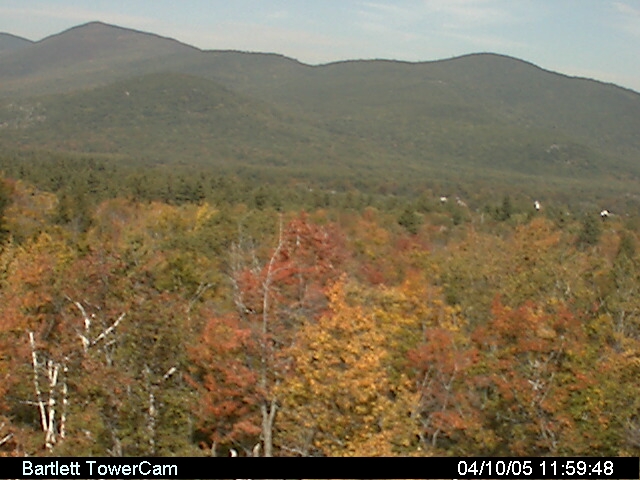
Hard to believe, but it’s been 20 years since a webcam was first put atop the Bartlett Experimental Forest AmeriFlux tower! The pictures from the Axis 211 weren’t great (the first recorded image, just before noon on October 4 2005 is shown below), but they were good enough. The data led to a 2007 paper in Oecologia that concluded “A network of cameras could offer a novel opportunity to implement a regional or national phenology monitoring program.” It turns out, that was a pretty good idea! This review paper in Agricultural and Forest Meteorology provides a more complete history of the PhenoCam network.
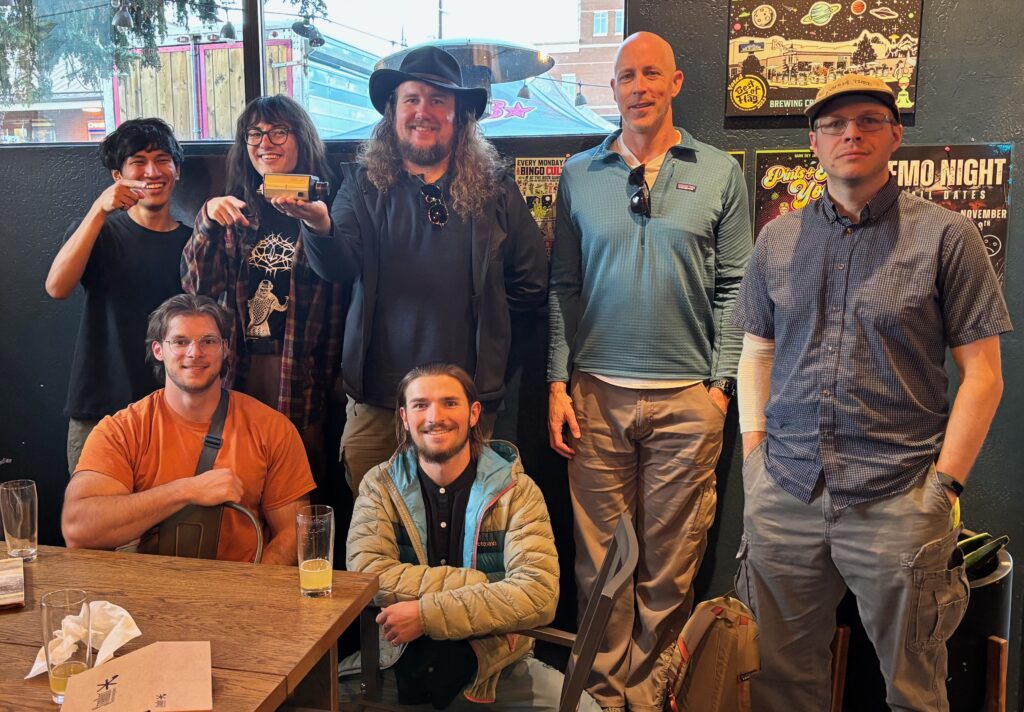
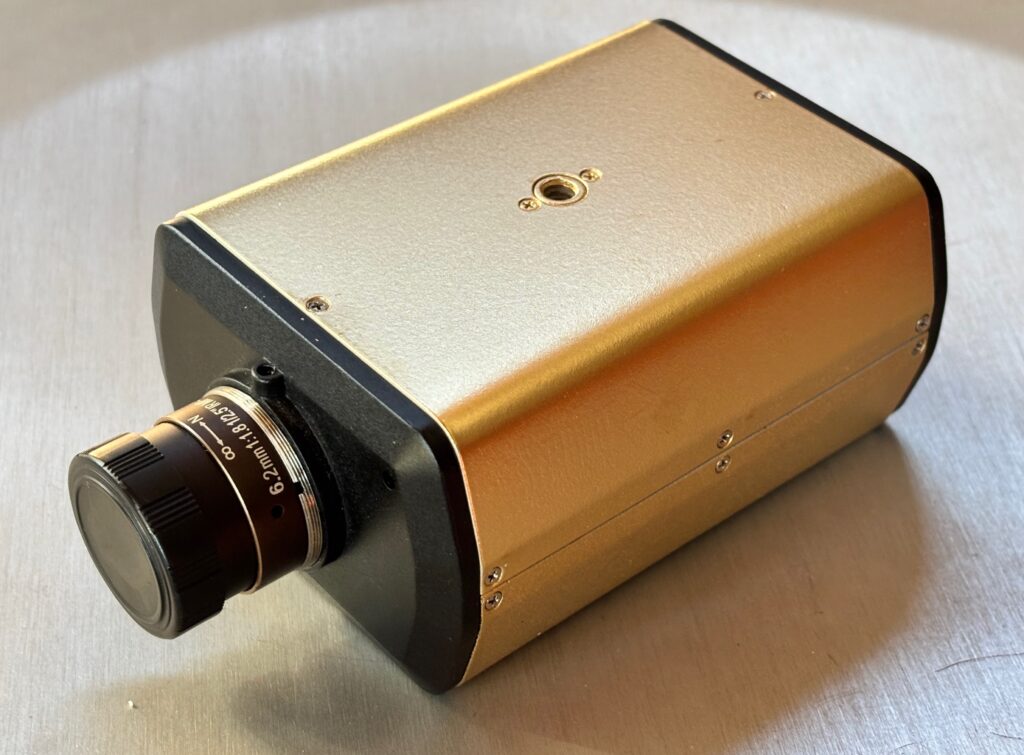
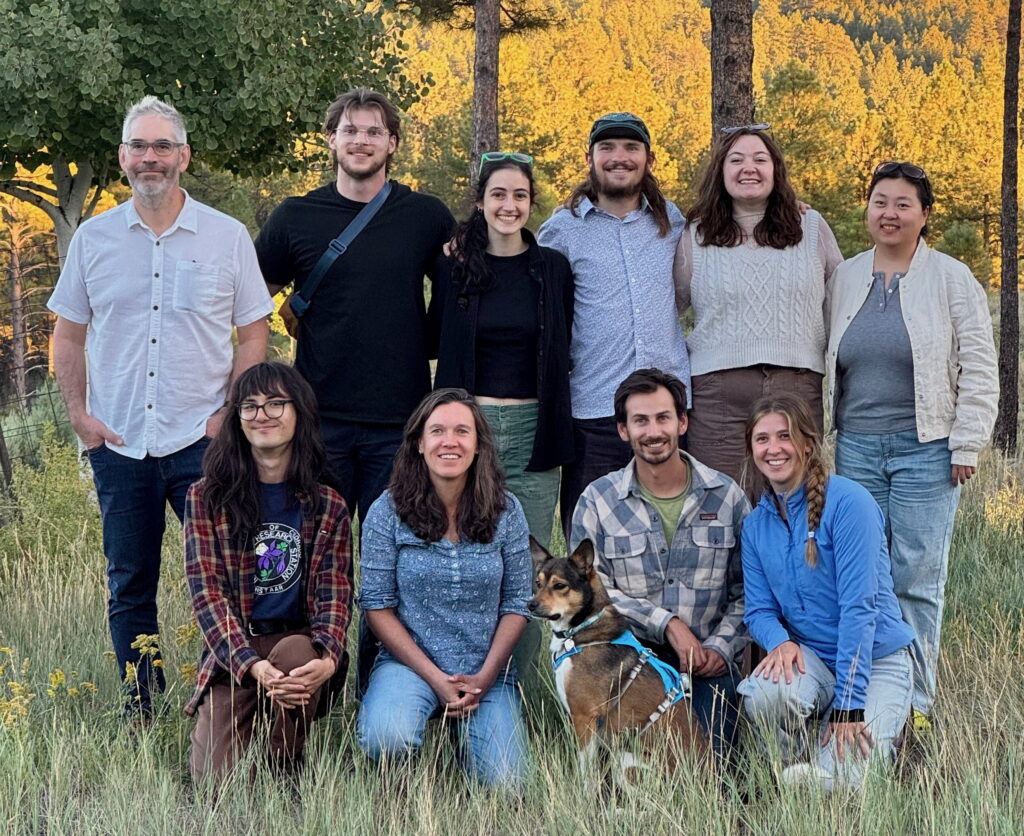
This week, core members of the PhenoCam team met up at Dark Sky Brewing to celebrate the recent acceptance in Earth System Science Data of the paper documenting V3 of the PhenoCam dataset. The dataset covers through the end of 2023 and contains almost 5000 site years of data. The data curation team did a super job vetting the phenological time series for each PhenoCam site included in the paper, but ultimately it was Keith’s wizardry with server and filesystem management, ability to dig in and resolve obscure edge-cases and bugs, and tenacity when it came to delivering approximately 40 TB of data and imagery to the ORNL DAAC, that was essential to the successful completion of this effort. For his invaluable contributions to the PhenoCam V3.0 dataset, Keith was awarded the coveted Golden PhenoCam. Thank you for all your efforts, Keith.
Congratulations to Jen, who was selected as an Outstanding Graduate Student in the Steve Sanghi College of Engineering (SCE) for Fall 2025. SCE Dean Charles Chadwell summarized Jen’s exceptional accomplishments: “You were awarded the highly selective NASA FINESST fellowship to support your work, and you independently secured approximately $35,000 in funding to organize and lead an international workshop at Hat Ranch, bringing together 40 participants from 10 countries. The outcomes of this workshop were featured in AGU’s EOS news magazine, underscoring the impact of your efforts. Your scholarly contributions are already impressive, with your first paper published in Environmental Research Letters and a coauthored article in PNAS. You have also shared your research widely through oral presentations at venues such as the Flagstaff Gravity Lab, the 2024 AmeriFlux Meeting at UC Berkeley, Universidad de Sonora, the AGU Fall Meeting in Washington, DC, and the University of Plymouth in the UK. Your ability to secure funding, publish in top journals, and present internationally highlights your leadership, initiative, and the global relevance of your work.”
With the end of September marking the end of the water year, it’s a good time to look back on this year’s summer rainfall, and compare it to previous years. While the summer monsoon season “officially” runs from June 15 to September 30, it’s not like rain in May and early June doesn’t matter. So, the graph above compares cumulative precipitation over the period from May 1 to late October. And, although well into August it looked like 2025 might be a total dud, or what some call a “non-soon,” abundant rainfall over the last six weeks turned things around. As measured by a Campbell Scientific ClimaVue all-in-one weather station located in the Forestdale neighborhood of southeast Flagstaff, the official precipitation total from May 1 to today (October 1) is a very respectable 197.4 mm, or 7.8″. Compared to the previous 5 y, it’s almost three times as much as the ultra-dry summer of 2020, but about 40% less than the epically-wet summer of 2021.
Fun fact: The final September rain in Flagstaff brought the first autumn snow to the highest summits of the San Francisco peaks, although it melted away by mid-day.
Andrew met up with PBS personality and Trail Mix’d host Kristen Keogh at 9000′ on Humphrey’s Peak for a wide-ranging interview that touched on changes in vegetation with increasing elevation, whether aspen need fire to reproduce, and what to expect with fall colors in 2025. Andrew’s bold prediction, 3 weeks out, is that aspen colors at Hart Prairie will peak between October 20 and 25, and that despite the dry summer the colors should still be “pretty good”. So far, the leaves aren’t changing much – but you can keep an eye on the changing seasons through the Hart Prairie phenocam!
On the final day of the 2025 Flagstaff Festival of Science, Andrew and other STEM professionals from NAU, USGS, and the Lowell Observatory participated in the event “Making STEM Digestible,” which was held at the USGS Astrogeology Science Center. The event was moderated by Greg Vaughan (USGS), whose research focuses on volcanic and geothermal phenomena.
To get the event rolling, Greg asked the panelists to describe the work they do first in technical and inaccessible language, and then in terms that (hopefully) the audience could understand. Andrew’s technical version: “In my research, we measure the fluxes of carbon dioxide, latent heat, and sensible heat between the land surface and the atmosphere. We do this using the eddy covariance method, which is a micrometeorological technique that uses 10 Hz measurements from a sonic anemometer and infrared gas analyzer to calculate the covariance between the vertical wind velocity and fluctuations in CO2, water vapor, and air temperature. When we gap-fill the resulting time series using machine learning methods we can estimate daily, monthly, and annual budgets of carbon and water for the ecosystem.” Hardly understanding a word, the audience was surprised to learn that Andrew is a forest ecologist!
The easier-to-understand version? “I use fancy instruments mounted above the forest canopy to measure the rhythmic “breathing” of trees. Trees breathe through tiny pores on the surface of leaves, known as stomata, with carbon dioxide being absorbed by the leaf, and water vapor being released. From my measurements we can learn how much trees are growing and how much water they are using.” Now that’s more digestible!
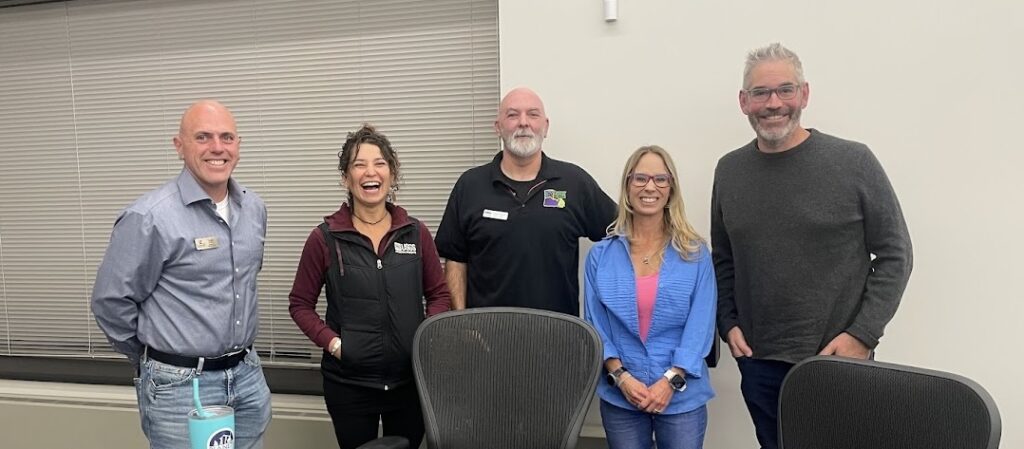
The photo shows (L to R) Todd Gonzales (Lowell Observatory), Anya Metcalfe (USGS), Greg Vaughan (USGS), Angie Hodge-Zickerman (NAU), and Andrew.
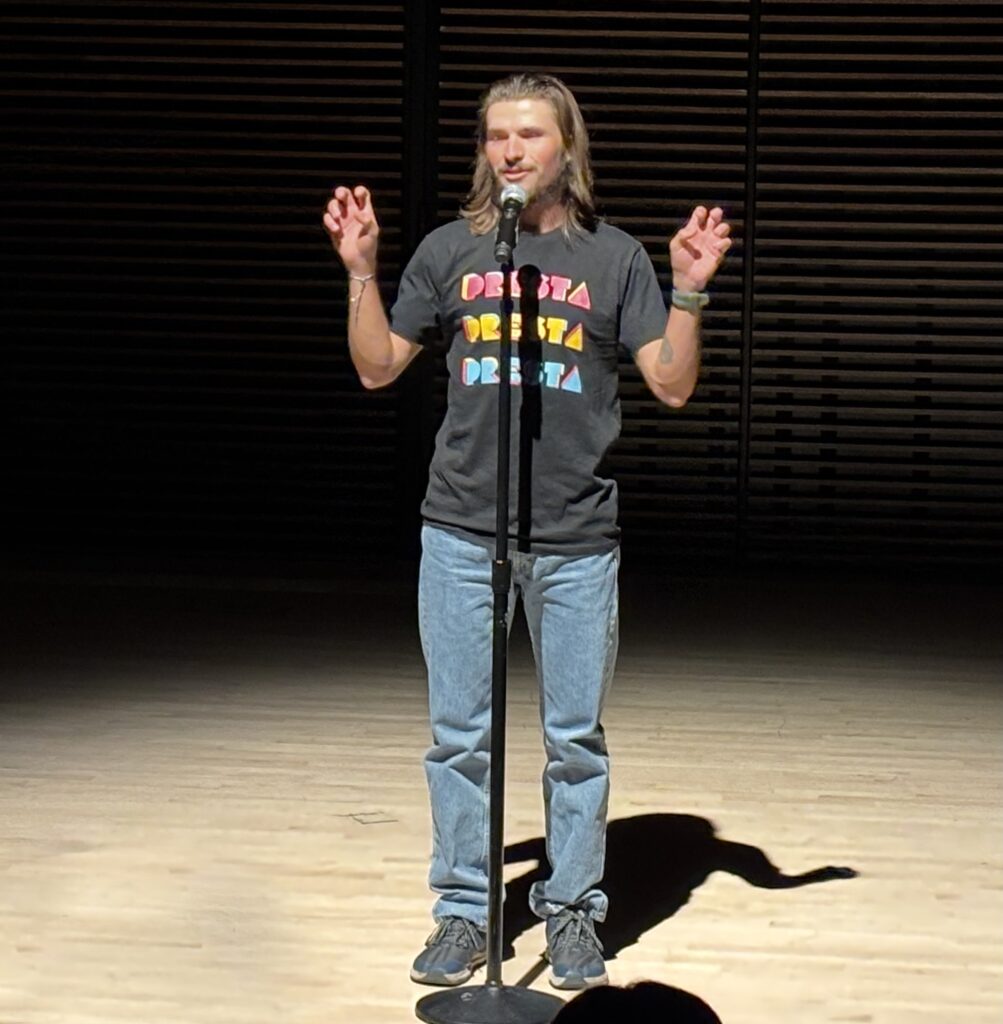
During an evening of steady cold rain and eerie thunder, Jacob told a personal story about how observing the impact of dramatic weather events on the desert landscape he grew up in is what led him down a career path in science. He told his story as part of the yearly Flagstaff Festival of Science event, “Science through Story.” The event is organized by ECOSS’s own Dr. Jane Marks in partnership with Writing Class Radio. In addition to learning about the importance of studying dryland ecosystems in response to changes in climate, Jacob also revealed to the audience a bit about his careless adolescent shenanigans. In the words of Andrea and Allison of Writing Class Radio, “Everyone has a story. What’s yours?”
Thanks to the support from a still-unknown nomination team, Andrew was one of 9 members of the American Geophysical Union’s Biogeosciences section to be named a 2025 Union Fellow.
It took a few weeks to find a date that worked for most of the lab, which is why it we didn’t have our first social get-together of the semester until week 5! But it was worth the wait, as we were treated to beautiful fall weather when the group gathered at Andrew and Mariah’s on a Wednesday evening in late September. Best wishes to all for the semester ahead!
As part of the 2025 Flagstaff Festival of Science, Mostafa and Darby led a hands-on PhenoCam workshop for the public. The session introduced participants to the PhenoCam Network, how we use PhenoCam data to study ecosystems, and how to navigate the PhenoCam website. We kicked things off with a simple but fun question: What’s your favorite season? To our surprise, almost everyone said spring—whereas at the 2024 workshop, autumn was the runaway winner! From there, participants were engaged from start to finish, repeatedly and enthusiastically jumping in with questions. These questions included what other metadata the PhenoCam Network provides (lots—including site characteristics such as land cover, climate regime, etc.), how many scientific publications have used PhenoCam data (almost 500), what “Gcc” means (green chromatic coordinate), and what kind of extra information near-infrared imagery could offer compared to standard visible-wavelength imagery (leaves absorb most visible light, but reflect most near-infrared light). Following that, participants got to do some investigating of their own, exploring a site they were interested in, following a worksheet that guided participants through the PhenoCam website. The mix of learning, discussion, and hands-on practice made the workshop both fun and rewarding.
All in all, it was another successful and memorable contribution to this year’s Festival of Science. Thank you for your efforts, Darby and Mostafa!
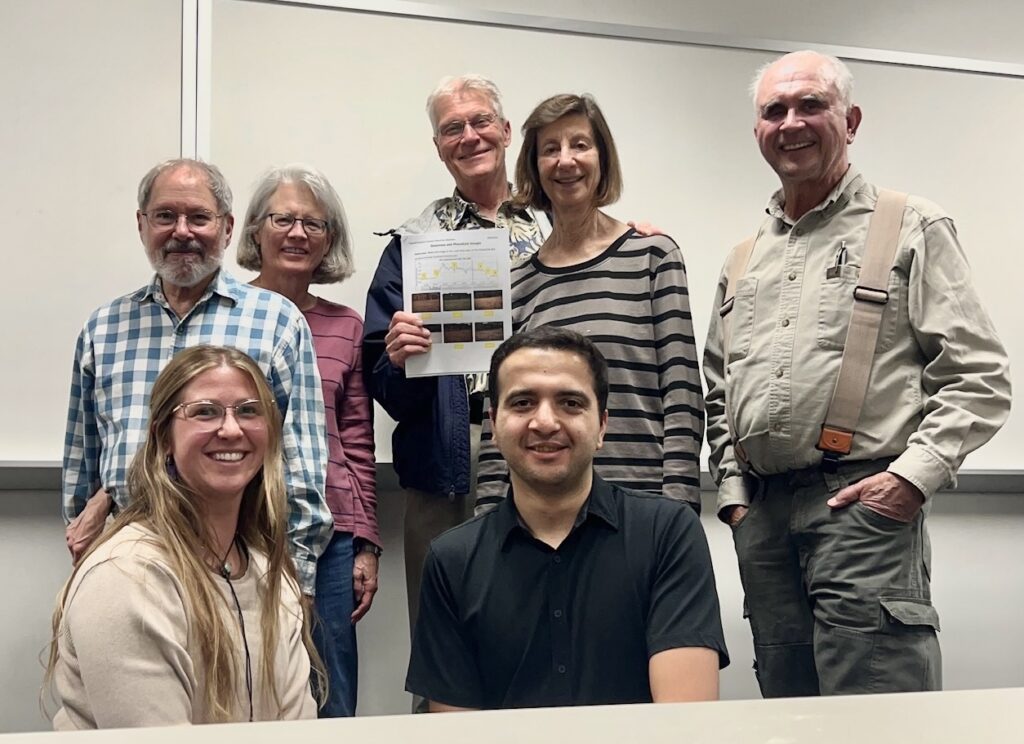
The photo below shows Darby and Mostafa (front row); former NAU Vice President for Research, Bill Grabe (back row, center) participated in the workshop with his wife, Fredericka.