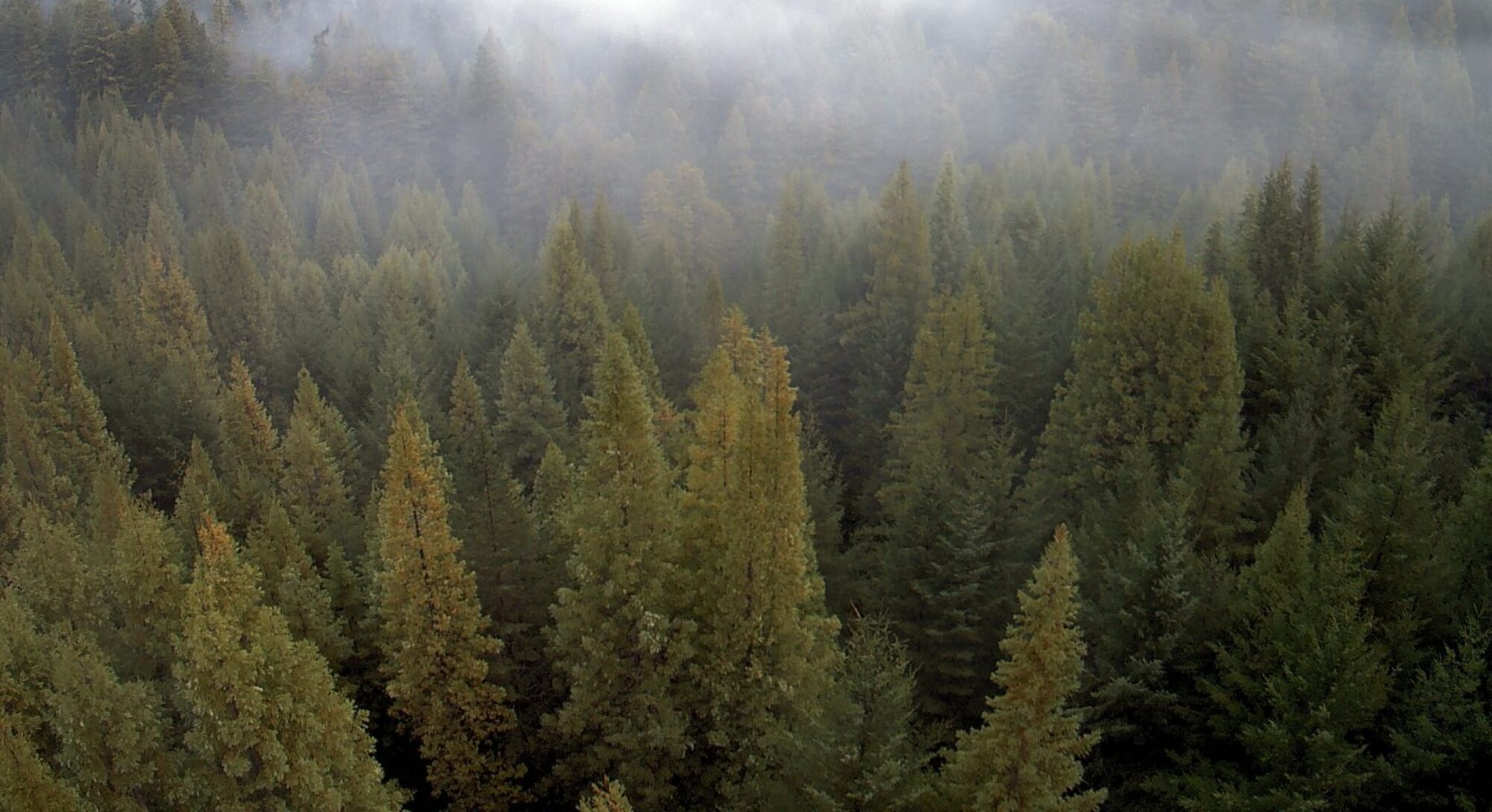
Andrew met up with PBS personality and Trail Mix’d host Kristen Keogh at 9000′ on Humphrey’s Peak for a wide-ranging interview that touched on changes in vegetation with increasing elevation, whether aspen need fire to reproduce, and what to expect with fall colors in 2025. Andrew’s bold prediction, 3 weeks out, is that aspen colors at Hart Prairie will peak between October 20 and 25, and that despite the dry summer the colors should still be “pretty good”. So far, the leaves aren’t changing much – but you can keep an eye on the changing seasons through the Hart Prairie phenocam!
On the final day of the 2025 Flagstaff Festival of Science, Andrew and other STEM professionals from NAU, USGS, and the Lowell Observatory participated in the event “Making STEM Digestible,” which was held at the USGS Astrogeology Science Center. The event was moderated by Greg Vaughan (USGS), whose research focuses on volcanic and geothermal phenomena.
To get the event rolling, Greg asked the panelists to describe the work they do first in technical and inaccessible language, and then in terms that (hopefully) the audience could understand. Andrew’s technical version: “In my research, we measure the fluxes of carbon dioxide, latent heat, and sensible heat between the land surface and the atmosphere. We do this using the eddy covariance method, which is a micrometeorological technique that uses 10 Hz measurements from a sonic anemometer and infrared gas analyzer to calculate the covariance between the vertical wind velocity and fluctuations in CO2, water vapor, and air temperature. When we gap-fill the resulting time series using machine learning methods we can estimate daily, monthly, and annual budgets of carbon and water for the ecosystem.” Hardly understanding a word, the audience was surprised to learn that Andrew is a forest ecologist!
The easier-to-understand version? “I use fancy instruments mounted above the forest canopy to measure the rhythmic “breathing” of trees. Trees breathe through tiny pores on the surface of leaves, known as stomata, with carbon dioxide being absorbed by the leaf, and water vapor being released. From my measurements we can learn how much trees are growing and how much water they are using.” Now that’s more digestible!
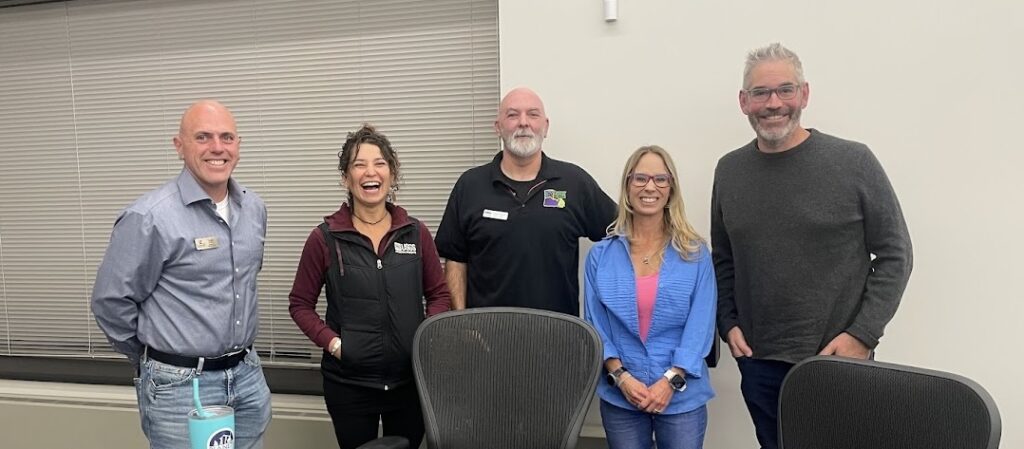
The photo shows (L to R) Todd Gonzales (Lowell Observatory), Anya Metcalfe (USGS), Greg Vaughan (USGS), Angie Hodge-Zickerman (NAU), and Andrew.
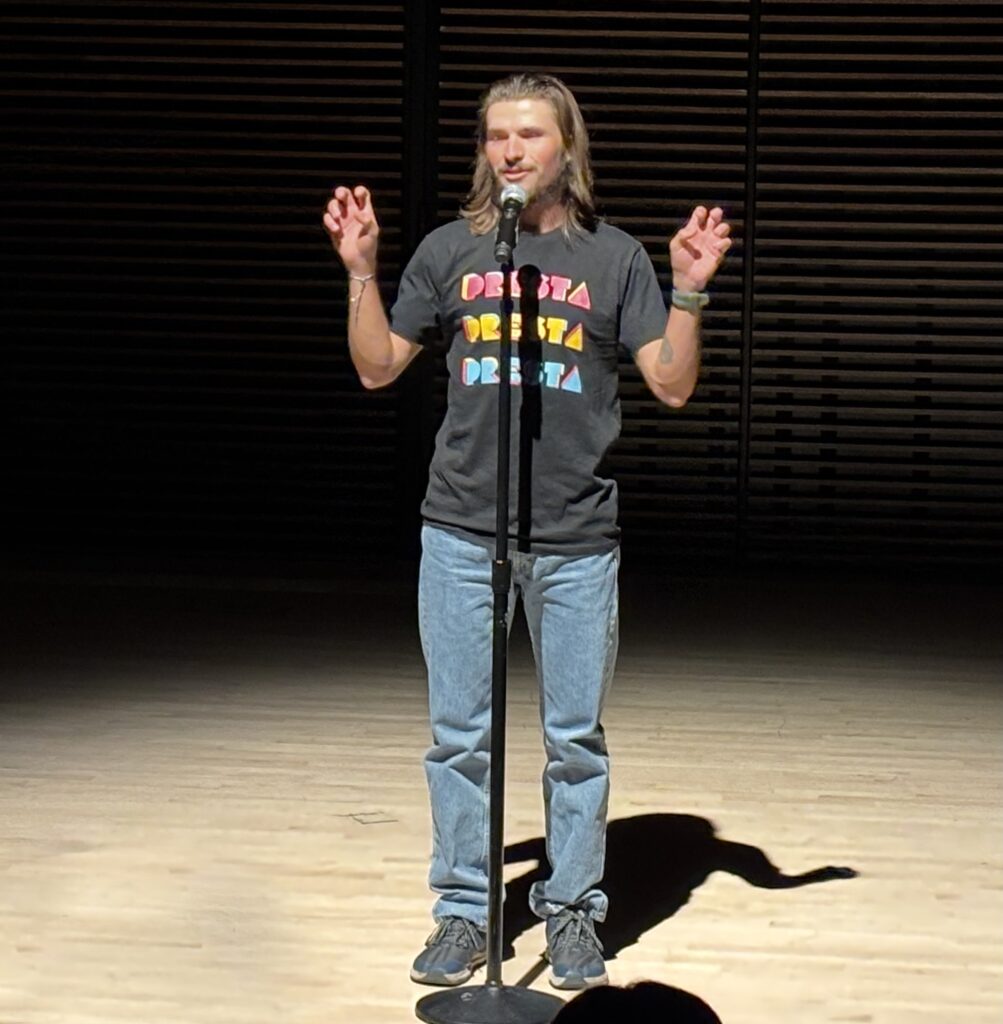
During an evening of steady cold rain and eerie thunder, Jacob told a personal story about how observing the impact of dramatic weather events on the desert landscape he grew up in is what led him down a career path in science. He told his story as part of the yearly Flagstaff Festival of Science event, “Science through Story.” The event is organized by ECOSS’s own Dr. Jane Marks in partnership with Writing Class Radio. In addition to learning about the importance of studying dryland ecosystems in response to changes in climate, Jacob also revealed to the audience a bit about his careless adolescent shenanigans. In the words of Andrea and Allison of Writing Class Radio, “Everyone has a story. What’s yours?”
Thanks to the support from a still-unknown nomination team, Andrew was one of 9 members of the American Geophysical Union’s Biogeosciences section to be named a 2025 Union Fellow.
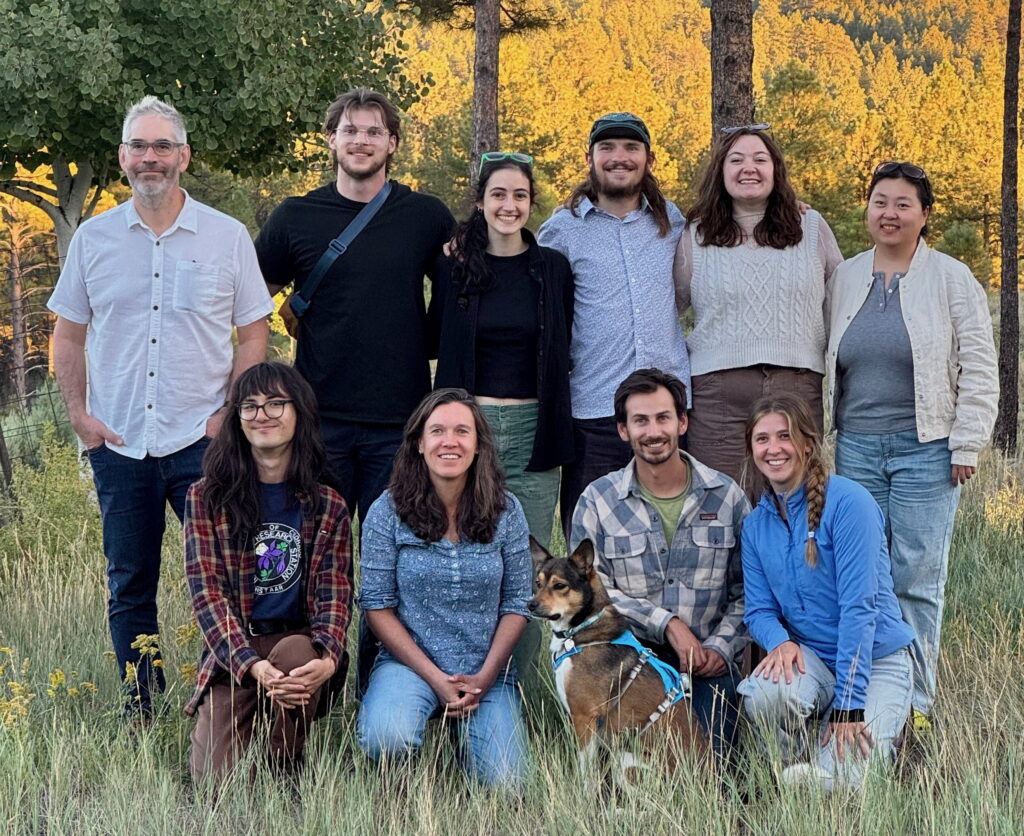
It took a few weeks to find a date that worked for most of the lab, which is why it we didn’t have our first social get-together of the semester until week 5! But it was worth the wait, as we were treated to beautiful fall weather when the group gathered at Andrew and Mariah’s on a Wednesday evening in late September. Best wishes to all for the semester ahead!
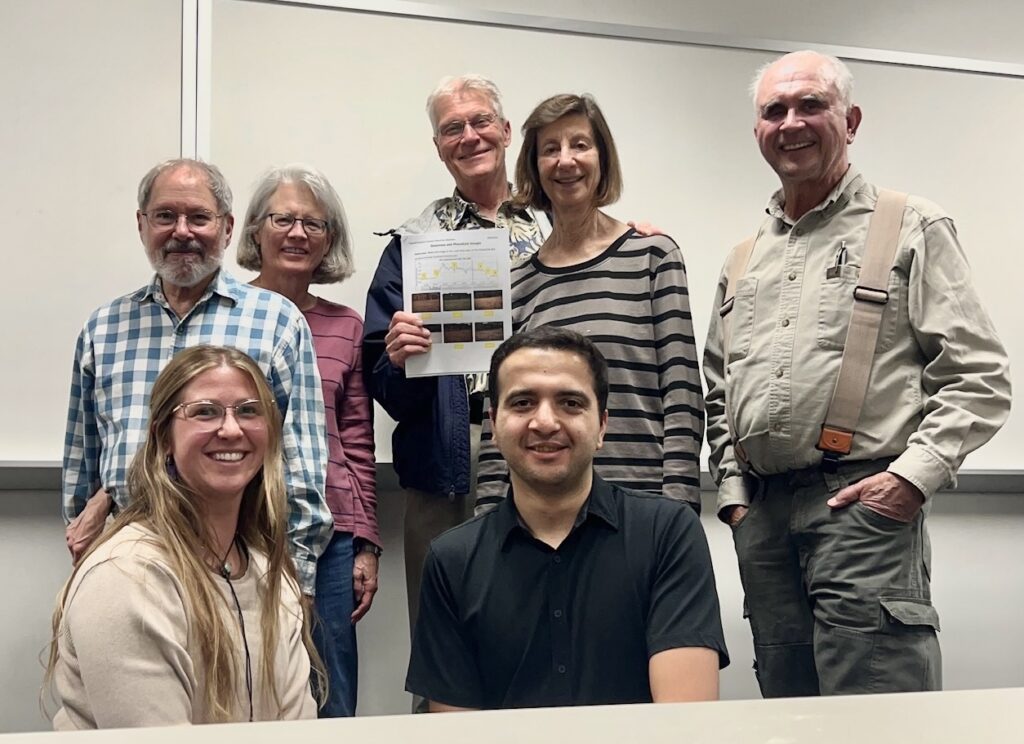
As part of the 2025 Flagstaff Festival of Science, Mostafa and Darby led a hands-on PhenoCam workshop for the public. The session introduced participants to the PhenoCam Network, how we use PhenoCam data to study ecosystems, and how to navigate the PhenoCam website. We kicked things off with a simple but fun question: What’s your favorite season? To our surprise, almost everyone said spring—whereas at the 2024 workshop, autumn was the runaway winner! From there, participants were engaged from start to finish, repeatedly and enthusiastically jumping in with questions. These questions included what other metadata the PhenoCam Network provides (lots—including site characteristics such as land cover, climate regime, etc.), how many scientific publications have used PhenoCam data (almost 500), what “Gcc” means (green chromatic coordinate), and what kind of extra information near-infrared imagery could offer compared to standard visible-wavelength imagery (leaves absorb most visible light, but reflect most near-infrared light). Following that, participants got to do some investigating of their own, exploring a site they were interested in, following a worksheet that guided participants through the PhenoCam website. The mix of learning, discussion, and hands-on practice made the workshop both fun and rewarding.
All in all, it was another successful and memorable contribution to this year’s Festival of Science. Thank you for your efforts, Darby and Mostafa!
The photo below shows Darby and Mostafa (front row); former NAU Vice President for Research, Bill Grabe (back row, center) participated in the workshop with his wife, Fredericka.
This weekend, Darby (shown below), Perry, and Rosie, an Ecoss undergraduate student, staffed the Ecoss booth at the Festival of Science’s “Science in the Park” event, and it was a hit! Kids and parents got to test their lungs in our “How much CO2 can you blow?” competition using the lab’s Flux Puppy CO2 measurement system. One superstar kid set a record at 39,200 ppm—that’s almost 4%! Through the challenge, they learned how our instruments measure CO2 and other gases, and then guessed which mason jar ecosystem—aquatic or terrestrial—was producing more CO2. Most guessed correctly: the jar with soil from a local ponderosa pine forest was the winner! We also had a station for spying on plants with digital cameras. A poster of PhenoCam images from Bartlett Experimental Forest showed how the forest changes through the seasons, and kids had fun identifying the start, peak, and end of the growing season. The beauty of these seasonal transitions even moved one visitor to tears! Overall, it was another fun, inspiring, and successful event.
NAU’s Advanced Research Computing Group (ARC) hosted an “HPC Day”, complete with a keynote address, workshops, and lightning talks. The event was a great opportunity for lab members to meet up with other members of NAU’s Monsoon HPC, and to meet face-to-face with ARC staff. Yujie gave a presentation in the lightning talks session, “Using HPC for gap-filling ecosystem fluxes”. The event was a huge hit, and thanks to ARC Director and PhenoCam collaborator Chris Coffey for organizing it!
With massive input from the lab, Andrew assembled a short video that emphasizes how PhenoCam imagery can convey the stories of how different ecosystems experience the passing of the seasons. The video will be shown at the Ecoss booth at the Flagstaff Festival of Science event, “Science in the Park.”
Jen’s paper, “Drivers of canopy temperature dynamics across diverse ecosystems”, has been published in Environmental Research Letters. This is the first of Jen’s thesis chapters to be published. Using data from 36 NEON sites across a range of vegetaion types, the paper takes an empirical approach to understanding how different environmental factors interact to drive the gradient between canopy temperature (Tcan) and air temperature (Tair). Incoming shortwave radiation was the dominant driver of daytime ∆T, and within vegetation types, the analysis shows similar sensitivities to all environmental drivers. An important finding is that the maximum Tcan–Tair gradient was well-correlated with vegetation height, which is thought to be related to the correlation between vegetation height and surface roughness, and impacts of roughness on canopy-atmosphere cooling. Congratulations, Jen!