Lab members make classroom visits to NPA

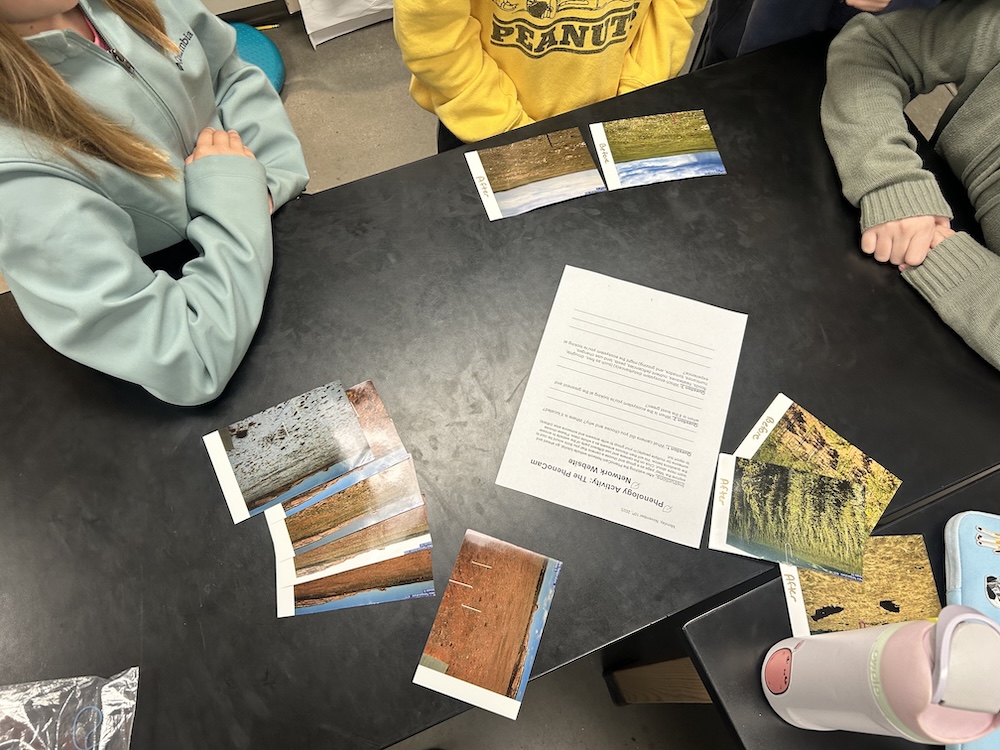
As part of the Flagstaff Festival of Science’s In-School Speaker Program, Perry, Jacob, Oscar, and Darby visited six 6th-grade classrooms at Northland Preparatory Academy in early November. They led hands-on lessons about how PhenoCams are used to track vegetation changes across different ecosystems. Throughout each hour-long session, students remained engaged as they worked with real PhenoCam images. They sorted photos into seasonal sequences based on visual cues from various ecosystems, identified types of environmental disturbances captured by the cameras, and even explored a PhenoCam site independently to determine when the vegetation in that ecosystem was at its greenest and when it was least green. The students also learned how to use metadata from the cameras, such as temperature and time of year, to inform their decisions when arranging the images into the correct seasons. One particularly thought-provoking moment came when they were asked why it’s important to have cameras capturing repeated images from the same location over time. Many correctly concluded that this setup is essential for monitoring long-term changes in vegetation greenness driven by environmental changes, showing a good understanding of the scientific process behind PhenoCam research. By the end of the day, the lesson led to an exciting conversation between students and their teacher about how they might incorporate the PhenoCam into their current unit on ecology.

Great job, Perry, Jacob, Oscar, and Darby!
Oscar, Yujie, and Andrew participate in AmeriFlux 2025

In late October, members of the lab traveled 4 hours south to Tucson, where the 2025 AmeriFlux meeting was being held at the University of Arizona. Oscar presented his work on near-surface remote sensing in pinyon-juniper woodlands; Yujie presented her analysis of the continuity between paired NEON and AmeriFlux sites, and Andrew gave an update from the AmeriFlux Science Steering Committee and the PhenoCam Network. The meeting included a field trip to the amazing Arizona – Sonora Desert Museum, as well as a delicious conference dinner, and many stimulating talks and posters. It was a great opportunity to catch up with colleagues from across the US, and the Americas more generally.

The pictures below include the standard workshop photo, as well as snapshots from the tours to collaborator Russ Scott’s Santa Rita sites, and the U of A Laboratory of Tree Ring Research. Local host Dave Moore did a fantastic job of keeping meeting participants entertained and well fed (for some, karaoke after the first night’s dinner was a highlight).

Yujie and Mostafa attend NEON workshop

In mid-October, Yujie and Mostafa participated in the NEON Convergence Summit 2025: Advancing Continental-Scale Biology, hosted by the NSF-funded National Ecological Observatory Network (NEON) in Boulder, CO.

The in-person facilitated summit brought together NEON staff, NEON Ambassadors (including Yujie), and researchers from across the country. Participants gathered to explore innovative and interdisciplinary ways to use NEON data, samples, and infrastructure to advance continental-scale biology.

A key outcome of the summit was the formation of enthusiastic and motivated working groups, who will collaborate on impactful outputs including writing proposals and white papers, and developing new resources for the community.

The photo shows Yujie on a pre-workshop field trip to the Central Plains Experimental Range (CPER) NEON site, 75 km to the northeast of Boulder.