Visit from METER Group

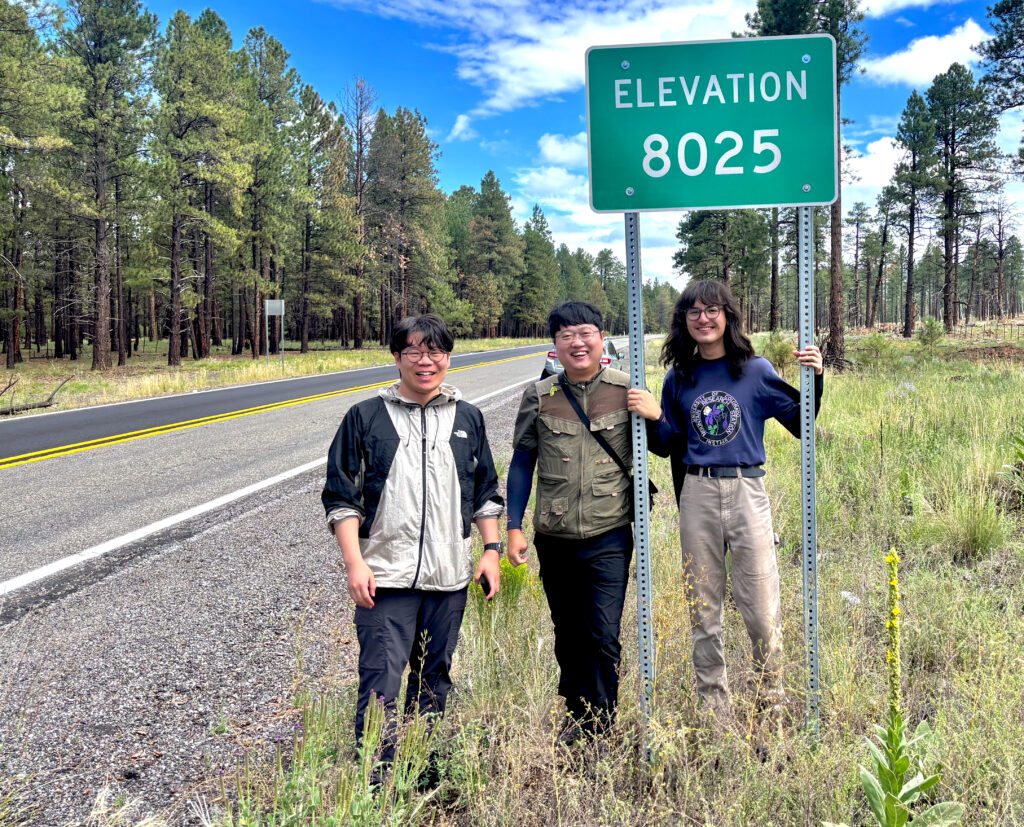
For quite a few years, the lab has been using METER Group’s all-in-one meteorological sensor, which measures air temperature, relative humidity, solar radiation, precipitation, wind speed and direction, barometric pressure, lightning strike frequency and distance, and sensor tilt. We’ve had many of these instruments installed at sites in Arizona, Colorado, and New Mexico, for both long-term installations and short-term measurement campaigns.

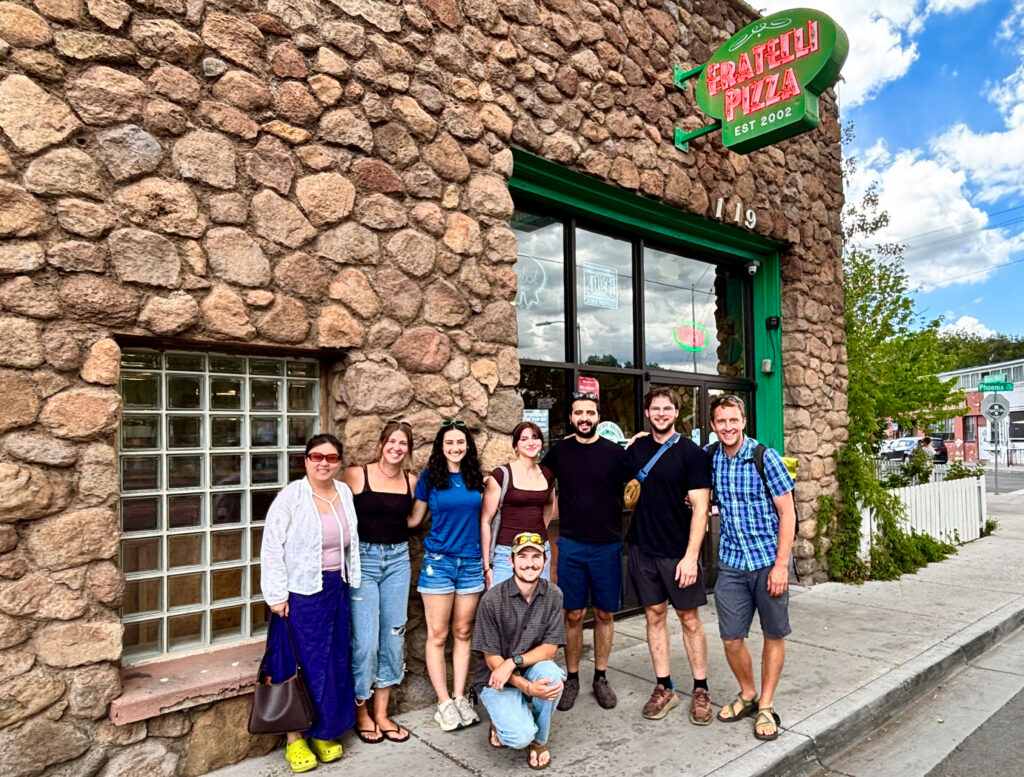
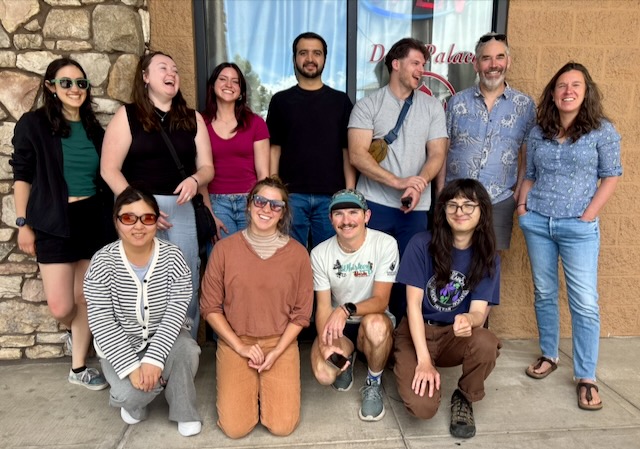
In mid-March, we had a visit from Chris Chambers and Carol McFarland from METER Group (formerly Decagon Devices). Chris gave a talk in the SICCS Informatics and Computing Weekly Seminar on “Designing measurement systems with biophysical insights”, and then after lunch at Martanne’s Burrito Palace, Chris and Carol held an “Office Hours” session where they were able to show off some of their new products to the NAU community. We then took a break for a well-attended happy hour “science session” at Mother Road.

After the visit, Carol noted that “it was lovely to learn more about your work, connect with some of your colleagues, enjoy some Flagstaff highlights, and meet your fantastic group of graduate students!”

Thanks to you both, Carol and Chris, for a fun and informative visit!

Dendrometer party in the redwoods

Andrew and George Koch traveled to Mendocino County, California, to meet up with colleagues from Lawrence Berkeley National Laboratory and UC Davis at the new redwood flux towers at Jackson Demonstration State Forest near Fort Bragg. With help from Housen Chu (LBNL) and Kosana Suvocarev (UC Davis), and their talented field crew, Andrew and George managed to get 61 automated point dendrometers and 11 soil moisture sensors installed within the footprints of the Parlin and Mitchell towers. Former Richardson Lab visitor Deklan Mengering is now part of the UC Davis team, and UC Davis PhD student Lily Klinek (who visited NAU in January) also showed up to lend a helping hand.

A special bonus was the visit by Dr. Aaron Teets (NAU PhD 2022), who dropped by at the end of the trip for a seafood dinner with Andrew and George.

Thanks to everyone who helped make this a remarkably successful outing!

Pixels to Eniro Patterns 2026 Workshop

Over spring break, Jacob, Camelia (undergraduate in Computer Science), and Mike (PhenoCam Team / Advanced Research Computing) traveled to Lincoln, Nebraska for Pixels to Enviro Patterns (PEP) 2026. Hosted at the University of Nebraska-Lincoln, PEP 2026 was an NSF-funded science and storytelling workshop based around the powerful and continuously-evolving software called GRIME AI. Jacob, Camelia, Mike, and others have been working together on a project that leverages GRIME AI to use dynamic, instead of static, vegetation masks to derive phenological information from PhenoCam imagery of Jacob’s field sites in New Mexico.  Development of GRIME AI is funded by an NSF Geoinformatics grant awarded to Dr. Troy Gilmore at the University of Nebraska-Lincoln. Andrew is a co-PI on the grant. 

The workshop consisted of presentations about using time-lapse imagery and artificial intelligence technology for hydrological and ecological teaching and research. After returning to Flagstaff, Jacob noted that “seeing old friends and making new ones, and learning about cutting-edge science, really made the trip a treat!”

Undergrad Camelia Mosor awarded grant to study redwoods

During the fall semester, Camelia Mosor, Computer Science major and undergraduate in the ESSTE program in Ecoss, learned about potential applications of AI-based tools to assist with analysis and interpretation of PhenoCam imagery. Her interest led to working with Jacob on annotation of images from his work at the Sevilleta Mean-Variance Experiment in New Mexico. Now Camelia has a project that is all her own—she was just awarded a $6500 grant from the Save-the-Redwoods League for her proposal, Automated Fog Detection in Coast Redwood Forests.  Mentored by George Koch and Andrew, Camelia’s project will develop and train a machine learning model to detect the presence of fog in phenocam  imagery at 4 research sites in George and Andrew’s Redwoods Observatory Network. She will then use the model to describe recent fog history and relate it to other sensor-based indicators of fog at sites in Monterey County, Santa Cruz County, Sonoma County, and Del Norte County.  

Congratulations, Camelia, on this fantastic achievement!

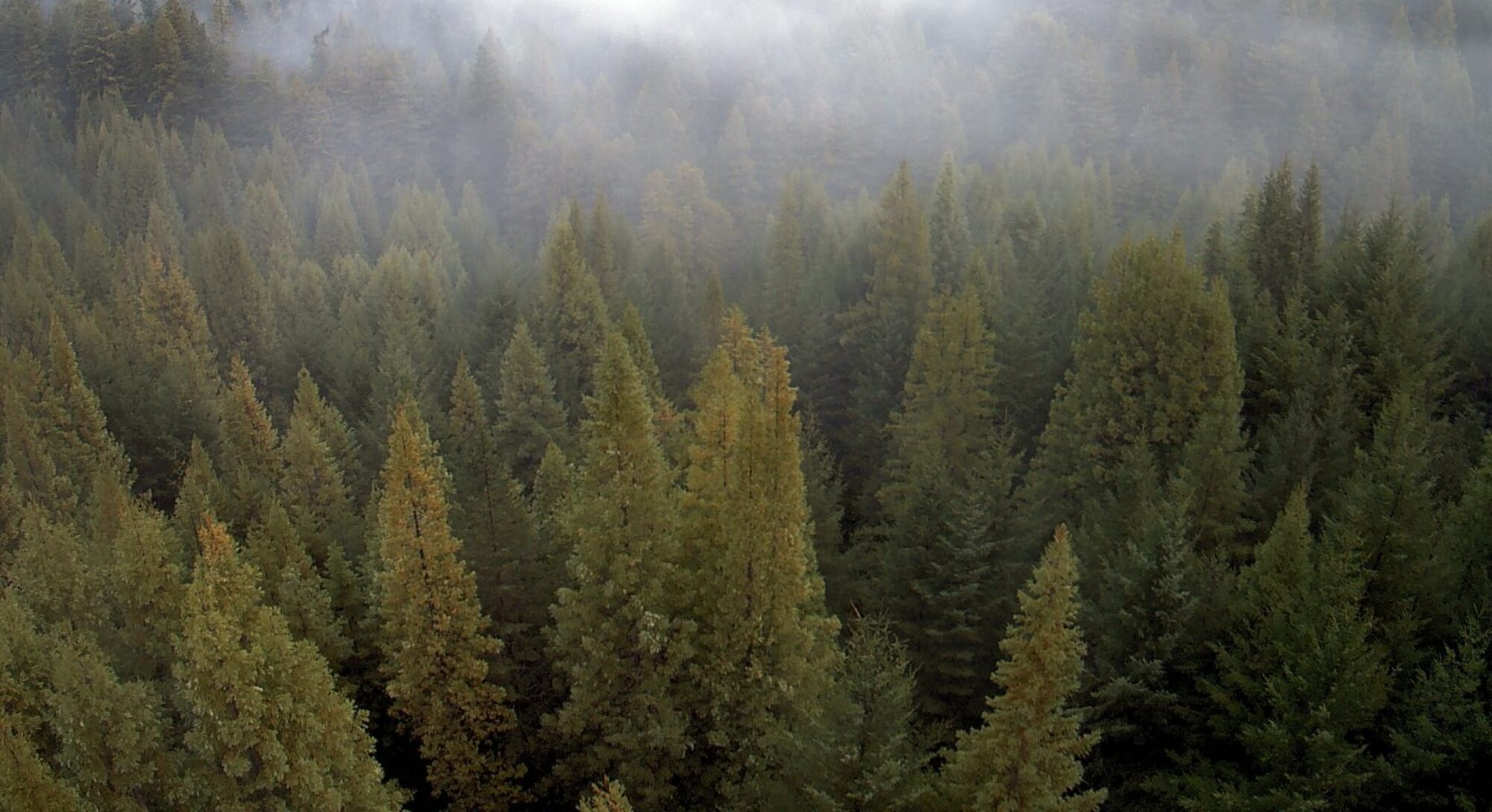
The fog comes
on little cat feet.

It sits looking
over harbor and city
on silent haunches
and then moves on.
— Carl Sandburg 

Tansley Review out in New Phytologist

Andrew is coauthor on a Tansley Review just published in New Phytologist, “Carbon uptake, storage, and allocation patterns contribute to blurring of annual 14C signals in tree rings.” Led by Amy Hessl, a paleoclimatologist at West Virginia University, the paper reviews how trees take up, store and use carbon and how these processes can affect the timing and strength of the radiocarbon “spikes” left behind in the atmosphere by past solar storms, known as Miyake events.  The paper emerged from a new NSF-funded collaboration between Hessl and Prof. Mariah Carbone.

Modeling led by Andrew and Mariah shows how tree biology has a fundamental impact on how faithfully the atmospheric signal is preserved. Andrew noted that “This study has a lot of implications for applications of carbon dating in fields such as archaeology, for example, as well as the use of radiocarbon in tree rings to reconstruct historical patterns of atmospheric radiocarbon.” 

Ecoss visual artist Victor Leshyk contributed a brilliant illustration that captures the underlying processes, reproduced below.

There is a write-up about the paper in the NAU Review.

Lily Klinek visits from UC Davis

After meeting up with Andrew and George Koch in Sonoma County earlier this month, Lily Klinek made a visit to NAU to talk more about redwoods and—and to learn more about the dendrometer measurements, supported by Save the Redwoods League, that Andrew and George have been making at sites from Del Norte county to Monterey County. Lily will be including these data in a range-wide synthesis of the timing and environmental sensitivity of redwood tree growth.

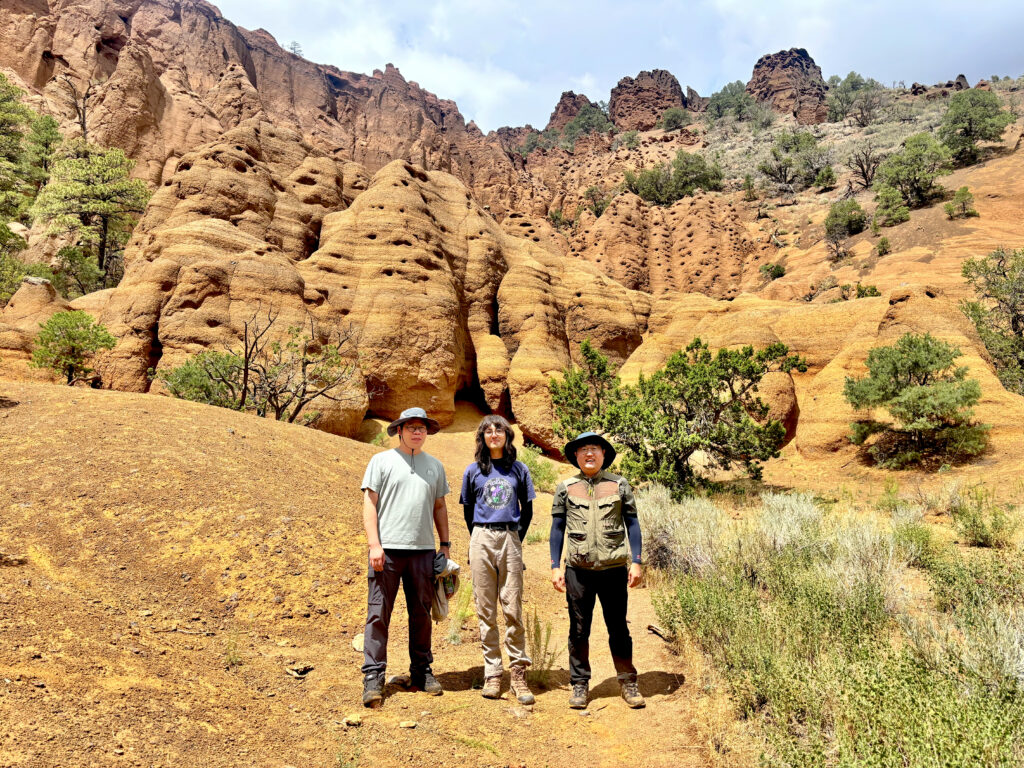
Lily had a chance to enjoy multiple social activities and get-togethers, including happy hour at Historic Brewing, a trip to Oscar’s “Blue Chute” pinyon-juniper field site (top photo), a hike into the cinder cone of Red Mountain, and a day trip to the Grand Canyon.

Jacob presents poster at SEV LTER All-Hands meeting

2026 is under way, which means the annual Sevilleta LTER All-hands meeting just took place at the comfortable UNM field station near la Jolla, New Mexico, about an hour south of Albuquerque. As always, exciting dryland science was shared in talks, a field trip, and a poster session; fresh collaborations were sparked, and old friends hand a chance to mingle; and dinners were chile-smothered.

Jacob attended the meeting and presented a poster on a new PhenoCam data processing workflow he is building, which uses the GRIME AI open source software to separate vegetation from bare soil in hundreds of thousands of PhenoCam images from the SEV Mean-Variance Experiment. The questions Jacob is investigating are: 1) does processing images using dynamic masks that separate vegetation and soil improve results compared to static masks that include both vegetation and soil? 2) how well does an AI-based image segmentation model trained on data from one study extrapolate to other study sites?

Jacob’s poster was a hit, and he spent so long answering questions that he almost missed dinner. He is already looking forward to the 2027 All-Hands Meeting!

Back in the redwoods!

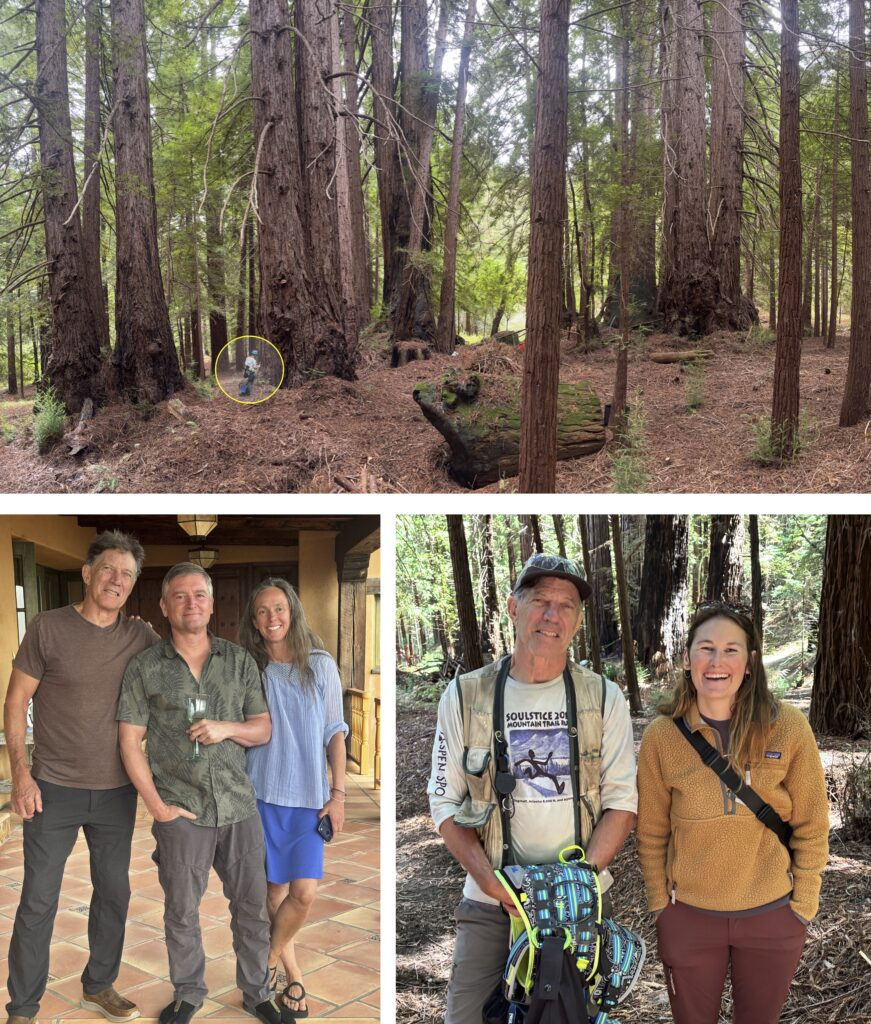
In the last week of the holiday break, Andrew and George Koch made a trip to visit their field sites in Northern California. Flying into Medford, OR, they then drove to Klamath, CA, where they visited Tree 51 in Redwood Experimental Forest. From there it was on to Save the Redwood League’s (SRL) Harold Richardson Preserve in coastal Sonoma County. After two days spent there (and two nights at Sea Ranch) they drove on to Big Basin Redwoods State Park, just north of Santa Cruz, before flying home out of San Jose.

The purpose of the trip was to conduct site maintenance and download data from Tomst point dendrometers, which had been installed along a vertical profile on one tree at each site. At Harold Richardson, a solar panel had to be re-mounted and some old equipment removed; at Big Basin, a new phenocam had to be installed.

Despite a dismal forecast (a series of atmospheric rivers had drenched the region during the preceding 2 weeks), the hardy arbornauts remained relatively warm and dry the entire trip.

It was a pleasure to meet up with former postdoc Drew Peltier and his student Declan (at Harold Richardson and Big Basin), as well as UC Davis PhD student Lily Klinek and SRL Senior Scientist Laura Lalemand (at Harold Richardson).

The photos show Andrew somewhere in Tree 51, and George playing Tetris with a dozen dendrometers.

Lab members present at AGU

In December, lab members Austin, Jen, and Darby attended AGU 2025 in New Orleans, held under the theme “Where Science Connects Us.”

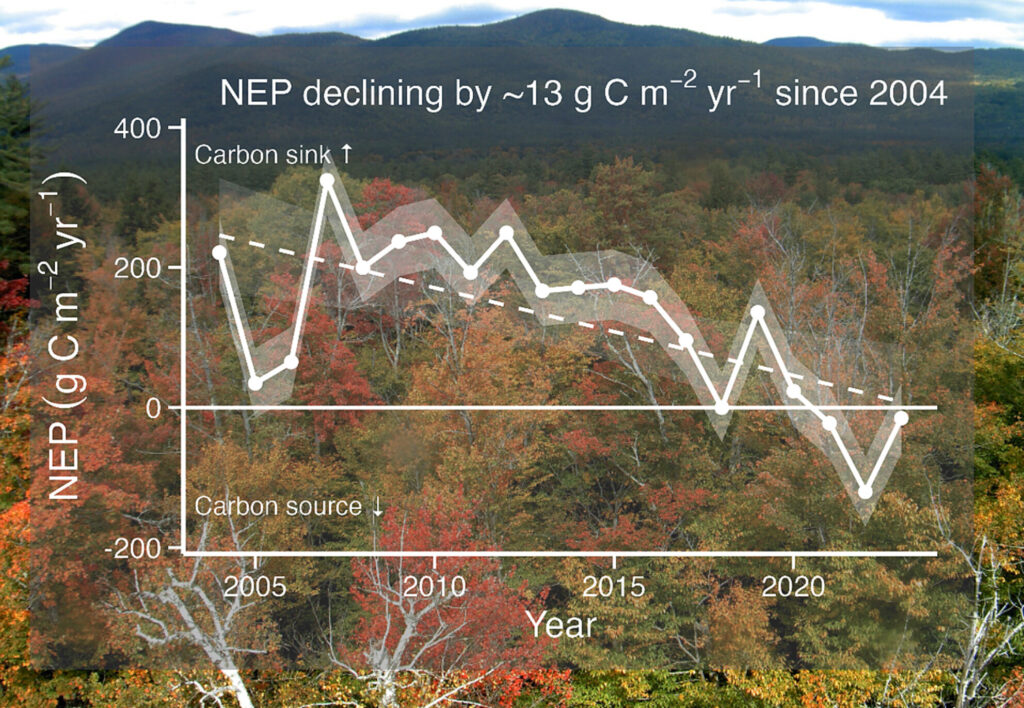
Highlights included a poster presentation by Austin titled “Winter Contributions of Root and Microbial Respiration to the Soil CO2 Flux in Mixed-Conifer and Aspen Forests,” a talk by Jen titled “Is Your Thermal Camera Telling the Truth? Assessing Measurement Accuracy for Ecosystem Science,” and a talk by Darby titled “Increasing Respiration Weakens the Carbon Sink over Two Decades in a Temperate Deciduous Forest.” 

The lab also contributed to two successful scientific sessions. Mostafa and Jen led the session “Advancing Environmental Monitoring Through Near-Surface Remote Sensing: Capabilities, Applications, and Future Directions,” while Darby served as a convener for the session “Quantifying Rates and Coupling of Biogeochemical Cycles in Terrestrial Ecosystems.”

See you at AGU next year!